HK SafeKids: The Complete Helper Management Platform for Families in Singapore, Hong Kong & Dubai
Most families stitch together an agency, a task app, a WhatsApp group and a training course. This replaces all four.
HK SafeKids is one platform for families employing a domestic helper — a helper, maid, amah or nanny. It brings online training, employer verification, daily childcare and elderly care reports, care trends, a full household operations schedule, and child safety and development activities into a single system — an app for the helper, a dashboard for the parent. Family Plan is HK$149 per month, roughly HK$35 a week. Registration is free and the 7-day trial needs no credit card.
Most platforms solve one problem. A job board helps you find a helper. A training app teaches one skill. A task app tracks to-dos. A reporting tool captures one type of data. Families end up running four or five disconnected things, and the coordination still lands on the parent.
HK SafeKids is built the other way round: the helper’s daily actions in one place become the parent’s visibility in the same place. That is the whole idea, and it is why the pieces are described below as one system rather than a feature list.
What Families Are Actually Searching For
Before the feature list, it is worth seeing what parents ask for — and how the language changes from market to market. The vocabulary matters, because it reflects genuinely different regulatory models.
Singapore
In Singapore the official term is Foreign Domestic Worker (FDW), regulated by the Ministry of Manpower. In daily conversation families say maid, helper, nanny and domestic helper. Common searches include how to train my maid, helper daily report app, FDW management app Singapore, childcare helper schedule, maid task list template, and helper care plan for elderly.
The intent is clear. Parents are not looking for another job board — they already have a helper. They want structure, proof and peace of mind.
Hong Kong
In Hong Kong the term is Foreign Domestic Helper (FDH), and every FDH must live in the employer’s home by law. Searches include 外傭訓練課程 (helper training course), helper daily report, domestic helper app Hong Kong, elderly care helper training, and household management app for helper.
Hong Kong families are especially focused on elderly care and child safety, because many households include both young children and ageing parents under one roof.
Dubai and the UAE
In Dubai and across the UAE the term is domestic worker or maid, governed by MOHRE. MOHRE-licensed Tawjeeh centres provide pre-employment orientation for domestic workers. But parents search for something beyond government orientation: maid training Dubai, nanny training UAE, childcare course for maid, elderly care helper UAE, and domestic helper management app.
The UAE market is particularly active because childcare and elderly care are the two most requested skills across Gulf households.
The common thread
Across all three markets, the searches fall into four buckets:
- Training — “How do I make sure my helper knows what she is doing?”
- Reporting — “What happened today while I was at work?”
- Safety and development — “Is my child safe? Is she learning?”
- Management — “How do I organise tasks, schedules and communication?”
Most platforms answer one of those four. This one is built to answer all four in the same place.
Why This Is Different
Here is the honest comparison. Each row is a need a family actually has, and what the platform does about it.
| What families need | What HK SafeKids provides |
|---|---|
| Online training | Full childcare and elderly care curriculum — helpers train themselves, in their own language |
| Employer verification | You verify your helper’s competency — not an agency, not a quiz score |
| Daily reporting | Childcare reports, elderly care reports and household task logs |
| Care trends | Health and wellbeing trends over time — sleep, mood, nutrition, safety |
| Task management | Full household operations schedule with custom and starred tasks |
| Child safety and development | Age-matched development activities and safety checklists |
| Mobile app | An app for the helper, a dashboard for the parent |
This is not a collection of separate tools bolted together. The helper’s daily actions in one place become the parent’s visibility in the same place.
1. Online Helper Training — The Helper Teaches Herself
The first pillar is training — but not training for the helper. Training by the helper.
In the traditional model an agency trains a helper before placement. After that, skills fade. There is no ongoing learning, and when the child grows the helper does not automatically grow with them.
HK SafeKids inverts this. Helpers sign up and train themselves through structured online courses covering:
- Childcare — newborns through school-age children: feeding, hygiene, sleep routines, age-appropriate play, behaviour management and emergency situations
- Elderly care — mobility assistance, medication reminders, dietary needs, dementia-friendly communication, fall prevention and dignity-first routines
- Home safety — fire safety, electrical hazards, child-proofing and secure handling of valuables
- Household operations — professional cleaning systems, kitchen hygiene, laundry and organisation
- First aid — CPR, choking response, burns, cuts, allergic reactions and when to call emergency services

The helper can train in her own language, on her own schedule, at her own pace. This is not a one-time course — it is an ongoing learning path that adapts as the family’s needs change.
What this means for parents: you are not paying for a training course. You are giving your helper the tools to get better at her job, which means better care for your family. See the full training curriculum →
2. Employer-Led Verification — You Decide When She Is Competent
This is where the platform is genuinely different from a course library.
Most training platforms issue a certificate automatically when a helper passes a quiz. That tells you she can answer questions. It does not tell you she can do the job in your home, with your child, following your standards.
HK SafeKids uses an employer-led verification system. The helper completes the training module. Then you — the employer — verify that you have seen her apply the skill in real life. You confirm competency. You sign off.
This is the same principle used in professional apprenticeships and clinical training. Knowledge is tested by a quiz; competency is verified by a supervisor.
The platform tracks twelve competency milestones, one for each course in the curriculum. As you verify your helper’s skills she earns badges and unlocks advanced modules. You see her progress, she sees her progress, and the relationship becomes a partnership rather than a set of instructions.
What this means for parents: you are not relying on an agency’s certificate. You are building your own record of what your helper can actually do — and that record stays with her, on her Professional Passport. See how the Professional Passport works →
3. Daily Reporting — Love Letters
The third pillar is daily reporting. We call them Love Letters.
Every day your helper files a report through the app. Depending on your family’s needs, that report covers:
- Childcare — what the child ate, how they slept, mood, activities, milestones and any incidents
- Elderly care — meals, medication, mobility, mood, hydration and any concerns
- Household tasks — what was completed, what was starred as a priority, what needs attention
These are not cold clinical checklists. They are narrative reports written in plain language. Parents receive a summary by email and can read the full letter in the dashboard.
What this means for parents: you stop wondering and stop guessing. You have a daily record of your child’s or parent’s day, written by the person who was there.
For parents in Singapore and Hong Kong working long hours, this is not a luxury. It is peace of mind. See how daily reports work →
4. Care Trends — See the Patterns, Not Just the Moments
Individual reports are valuable. But patterns are where real insight lives.
HK SafeKids aggregates daily reports into care trends for health and wellbeing. Over time you can see:
- Sleep patterns — is your child sleeping well? Are there changes?
- Mood trends — is your elderly parent happier or more withdrawn?
- Nutrition tracking — are meals balanced? Is hydration consistent?
- Safety incidents — are there recurring risks in the home?
- Activity levels — is your child getting enough developmental play?
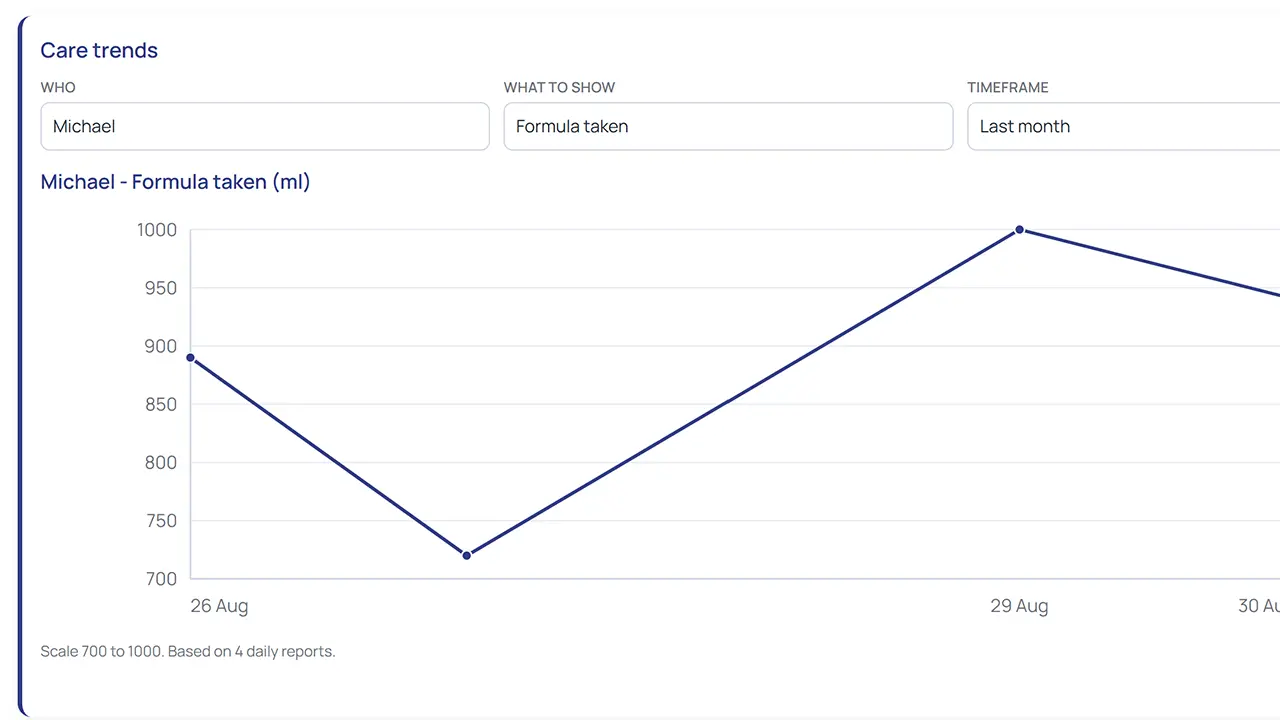
This is the same principle used in healthcare. A single data point is an anecdote; a trend is evidence.
For families caring for elderly parents, care trends can reveal subtle changes — a gradual decline in appetite, a shift in sleep — that a single day’s report would miss. For parents of young children, trends show developmental progress over weeks and months.
What this means for parents: you are not just reacting to today. You are seeing the bigger picture and making informed decisions about care.
5. Household Operations Schedule — The Full Task System
A helper’s job is not one thing. It is dozens of small tasks, repeated daily, weekly and monthly.
HK SafeKids includes a full household operations schedule with:
- A master task list covering every area of home care — child development, safety, kitchen, bathroom, laundry, floors, daily child care and admin. Over 300 tasks with documented standards and nearly 500 training procedures behind them
- Custom tasks that you add for your family’s specific needs
- Starred tasks — you highlight what matters most, and they become your helper’s priority focus
- Weekly rhythm — tasks organised by Morning, Daytime, Evening and Flexible, so the day has structure
- Rotation schedules — weekly, fortnightly, monthly and quarterly tasks rotate automatically
The helper sees her daily task list in the app. You see what has been completed. Starred tasks rise to the top.
What this means for parents: you stop repeating yourself. The system carries the instructions so you do not have to.
6. Child Safety & Development Activities
For parents of young children the platform goes beyond task management into child development.
It includes age-matched development activities your helper can do with your child. These are not generic suggestions — they are structured activities that build:
- Motor skills — through play and movement
- Language — through reading, talking and singing
- Social skills — through turn-taking and cooperative play
- Cognitive skills — through puzzles, sorting and problem-solving
The platform also includes safety checklists for every area of the home — fall prevention, poisoning, fire, water safety, choking and elopement risks.
What this means for parents: your helper is not just keeping your child safe. She is helping them grow.
7. The App and the Dashboard
HK SafeKids is not a website you check occasionally. It is an app and a dashboard, built for the two different people using it.
| The helper’s app | The parent’s dashboard |
|---|---|
| See her daily tasks | See your helper’s engagement and progress |
| Complete training modules | Read daily Love Letters |
| File daily reports | View care trends |
| Track progress and badges | Verify competencies |
| — | Manage tasks and schedules |
| — | Earn your own badges and rewards |
Everything is connected. Everything is visible. Nothing is hidden.
8. The Price
This is the part that matters most, so here is the actual number rather than a metaphor.
There is also a Helper Pro Plan at HK$49 per month for families who want the training and Professional Passport without the full management suite.
Compare that to what these things otherwise cost:
| Alternative | Typical cost |
|---|---|
| Agency fees in Singapore | SGD 1,000 – 3,000 |
| Agency fees in Hong Kong | HKD 8,000 – 25,000 |
| Private childcare training in the UAE | AED 1,500 – 3,499 per course |
| HK SafeKids Family Plan | HK$149 per month |
The platform replaces the need for multiple paid courses, replaces the agency’s training function, and replaces scattered WhatsApp messages. But the honest comparison is not really price — it is that none of those alternatives gives you verification, daily reporting and care trends in one place.
Start with the free trial
Full access to the master schedule, training modules and employer verification system for 7 days. No credit card required.
Start Your Free Trial →Frequently Asked Questions
Is HK SafeKids a hiring platform?
No. HK SafeKids is a management and training platform. You already have a helper. We help you train her, verify her competency, receive daily care reports and see care trends over time. We do not place helpers with families and we are not an employment agency.
Does my helper need to speak English to use the platform?
No. Training is available in multiple languages and the helper app can be used in her preferred language. The platform is built for Hong Kong, Singapore and the UAE, where helpers may speak Tagalog, Bahasa Indonesia, Cantonese or English.
Can I use HK SafeKids if I have both a child and an elderly parent?
Yes. The platform covers both childcare and elderly care, with separate reporting streams and separate care trends, so you can see how each person in your household is doing without mixing the two records.
Is there a contract or long-term commitment?
No long-term commitment is required. Registration is free, there is a 7-day free trial with no credit card required, and you can cancel at any time.
How is HK SafeKids different from a task app?
A task app tells your helper what to do. HK SafeKids records what she did, lets you verify that she can actually do it, and turns her daily reports into care trends you can see over weeks and months. It connects training, verification, reporting and trends in one system rather than handling one of those four.
How much does HK SafeKids cost?
The Family Plan is HK$149 per month, which works out to roughly HK$35 a week. Registration is free and there is a 7-day free trial with no credit card required. There is also a Helper Pro Plan at HK$49 per month for families who want the training and Professional Passport features without the full management suite.
What is employer verification and why does it matter?
Most online courses issue a certificate when a helper passes a quiz, which proves she can answer questions — not that she can do the job in your home. Employer verification means you confirm competency only after you have personally watched her apply the skill with your child or parent. That record is far more credible to a future employer than a quiz score.
What are Love Letters?
Love Letters are the daily care reports your helper files through the app. They cover what your child ate, how they slept, their mood, activities and any incidents — or the equivalent for elderly care. They are written in plain narrative language rather than as a clinical checklist, and you receive a summary by email each day.
Sources & References
- Ministry of Manpower (MOM), Singapore — Foreign Domestic Worker (FDW) regulation and employer requirements.
- Labour Department, HKSAR — Foreign Domestic Helper (FDH) employment framework, including the live-in requirement.
- Ministry of Human Resources and Emiratisation (MOHRE), UAE — domestic worker regulation and Tawjeeh pre-employment orientation.
- UAE Federal Decree-Law No. 9 of 2022 on domestic workers.
- HK SafeKids platform documentation — training curriculum, verification milestones, task standards and reporting structure.
One platform instead of five.
Start with the free trial.
Training, employer verification, daily care reports, care trends and a full household schedule — for HK$149 a month. No credit card required.
Register Free →Or see how it works at hksafekids.hk/how-it-works