Estimated reading time: 1 minute

So Why Do We Skip the Ones Who Care For Our Children?
Key Takeaways
- Domestic maid helper training in Hong Kong and Singapore lacks structured development and ongoing training for foreign domestic workers.
- Unlike other care professions, domestic helpers don’t receive competency assessments or opportunities for professional growth.
- HK SafeKids offers a verification-centered approach, ensuring that skills are not only learned but confirmed by the employer in real situations.
- Verified competencies provide helpers with a career path and families with assurance about their caregiver’s skills and knowledge.
- Continuous development through HK SafeKids encourages active employer involvement, changing how we view domestic helper training.
Ask anyone in an office job what their employer does for their growth and you’ll get a list. Training budget. Quarterly reviews. A subscription to some course platform nobody uses. An annual appraisal where someone tells them what they’re doing well and where they’re falling short.
Now ask a domestic helper.
For most of the 370,000-plus foreign domestic workers in Hong Kong, the answer is nothing. No structured training after arrival. No competency assessment. No pathway. No acknowledgement that the skills required to care for a child with anaphylaxis, or an elderly parent with dementia, are any different from the skills required to do laundry.
Singapore is the same story, at almost the same scale. There were 316,900 migrant domestic workers in Singapore at the end of 2025, up from 247,400 in 2020. Between them, the two cities are home to close to 700,000 people doing one of the most demanding jobs there is, with almost none of the professional development infrastructure that any other care profession takes for granted.
There is a lot of helpers who arrive in Hong Kong already experienced, already capable, and then spend years in a role where nobody ever asks them to develop further. That’s not a gap in the sector. It’s a gap in how we think about who deserves a career.
Other care professions don’t work this way
Nurses re-certify. Teachers do CPD hours. Social workers have supervision and case reviews. Even aged care workers in most developed markets have mandatory ongoing training, because we accept as a society that caring for vulnerable people requires skills that decay without practice.
Caregiving inside a home is arguably more demanding than any of those. You’re alone. There’s no colleague to ask. The person you’re caring for can’t always tell you when something is wrong. And unlike a hospital, there’s no one checking your technique.
The training exists, it just isn’t offered to them. That’s the whole problem in one sentence.
Finishing a course is not the same as being competent
This is where most online training falls apart. You watch a video, you answer five multiple choice questions, you get a certificate. Nobody ever watched you actually do the thing.
Would you accept that from a driving instructor? A surgeon? A lifeguard?
Competence isn’t knowledge. It’s knowledge applied, under real conditions, and confirmed by someone who saw it happen. In caregiving, the person best placed to confirm it is the employer — the parent who watches the helper every day, who sees how they handle a seizure plan, how they respond when a child’s airway tightens, how they speak to an elderly person who’s frightened.
Less platforms are willing to build that into their model because it’s hard. It requires the employer to actually participate.
What HK SafeKids does differently
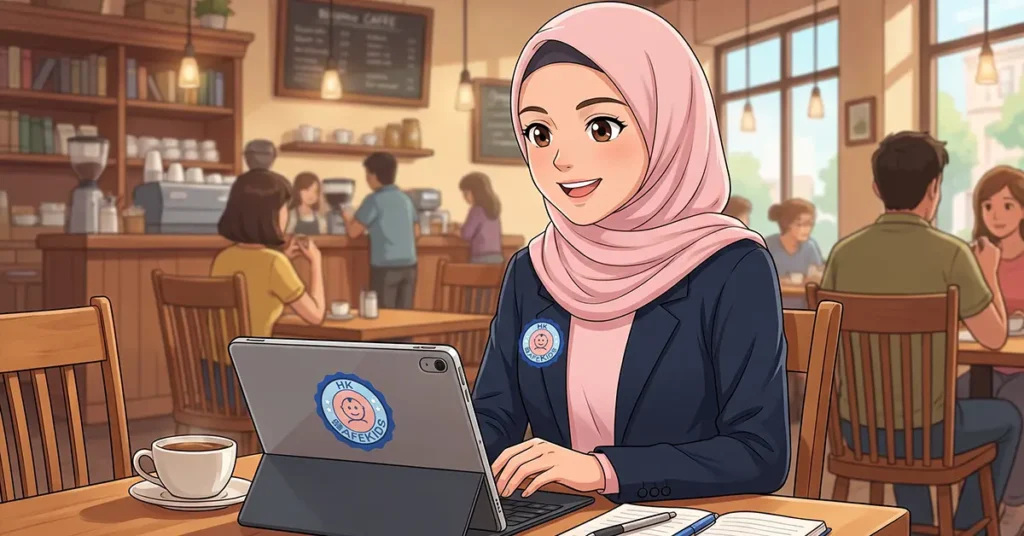
HK SafeKids is the only platform that devotes itself to the ongoing professional development of helpers, and the difference is that verification sits at the centre of everything.
The structure is simple. A helper works through courses on the things that actually show up in their day — child development, allergy response, seizure protocols, dementia care, mobility support, safe transfers. Then they apply it. Then the parent verifies that the skill was demonstrated in practice, not just completed on a screen.
That verification is what turns a certificate into a competency.
It’s recorded. It’s permanent. It follows the helper. And it earns them recognition — points, badges, a visible record of what they’ve actually proven they can do. The Verifier badge isn’t for watching videos. It’s for five confirmed competencies, signed off by the person who saw them.
We’ve spent 30 years building systems, and we brought vocational education standards from Australia into childcare safety management and domestic duties work, then developed the platform that lets parents deliver the training and helpers earn the HK SafeKids Certified Helper recognition. We want to be clear about what that is and what it isn’t: it is not a government-recognised qualification, and we are not a training provider. It’s real workplace procedures, training in those procedures, and employer verification of competency — the same way every other profession builds and proves skill.
Why this matters more than a certificate on a wall
For the helper, it’s a career instead of a job. Skills that are documented and verified are portable. They’re evidence. They’re the difference between “I’ve looked after children for eight years” and “I’m certified in paediatric allergy response and my employer verified I can administer an EpiPen correctly under pressure.”
That second sentence changes a negotiation.
For the family, it’s safety. The child profile lists the allergies, the special needs, the environment risks, the medical notes. The elderly profile lists the care needs, the medications, the mobility aids, the specific instructions that matter for that person. When a helper has verified competency against those exact requirements, the parent isn’t hoping. They know.
And every daily report a helper writes feeds back into that loop — a record of what happened, what was noticed, what was managed.
Parents deserve the best care for their helpers, and we have the skills and experience to design a program that gives helpers some fun and enjoyment while they gain recognition — and, more importantly, gives children safer care and parents peace of mind. Our modules cover how helpers can actively work on child development, so parents are getting real value rather than just babysitting. We’re not replacing the relationship — we’re giving both sides the tools to work together.
Development shouldn’t stop at arrival
The domestic helper system in Hong Kong is built around getting someone here and getting them working. Almost nothing is built around what happens in year three, year five, year ten. Singapore’s system, for all its different rules and safeguards, shares the same blind spot: the worker arrives, the placement begins, and professional growth is nobody’s job.
That’s the part HK SafeKids is trying to change. Not with a one-off course, but with a continuous loop — learn, apply, verify, recognise, repeat — where the employer is an active participant in the helper’s growth rather than a passive beneficiary of it.
Every worker deserves professional development. The people raising our children and caring for our parents deserve it more than most.
Register free. Start building a safer home today.
Choose the plan that fits your family — or your helper.
Family Plan — $149 HKD / month
Full access for the Parent and Helper. Courses, child and elderly safety profiles, chart tends in health and wellbeing, daily reports, and employer verification of competency — the complete HK SafeKids Certified Helper program.
Helper Pro Plan — $49 HKD / month
Training-only access. For helpers whose employer isn’t ready to join the full program yet. Work through the courses on your own, build real skills, and earn recognition at your own pace. Fun and engaging way to promote yourskills. Helpers also recieve a free CV Builder to make thier own Resume without being locked down to an agency. You make it edit it and send it to whoever you want.
Registration is free. You only pay when you’re ready to start. Cancel anytime.